Lesson 30 · The Stable Story · Chapter 5
Build the Stable Dashboard
Choose what the team controls, then measure what responds.
26 · Audit27 · Build28 · Investigate29 · Present30 · Organise31 · Open
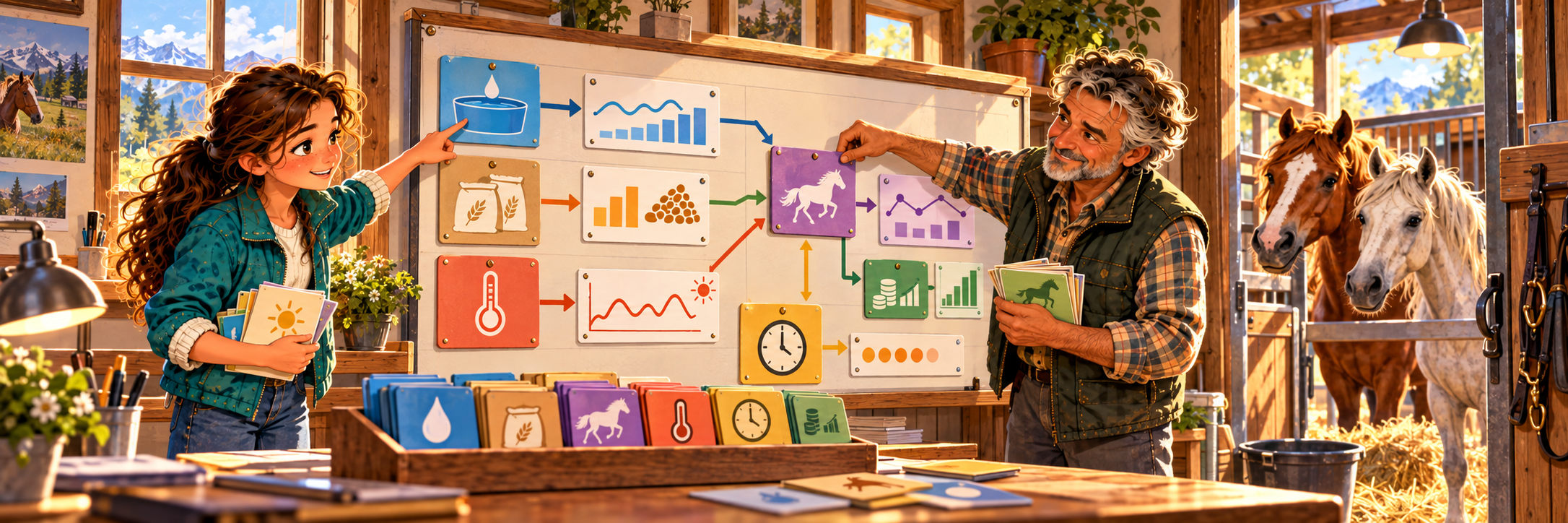
The grant is approved—with one condition.The committee pays for the new valve and monitor, but the stable must keep clear records. Herr Berger cannot act on a dashboard labelled only “number” and “amount.” Every graph must say what the team chose or allowed to pass first, what responded, and which units belong on each axis.
Mia has one afternoon to design that dashboard before the final inspection. A reversed ordered pair could turn “240 litres after 3 minutes” into the impossible claim “3 litres after 240 minutes,” so variable roles are a safety issue as well as a vocabulary lesson.
If Mia changes how many riding lessons the stable offers, its earnings change too. The number of lessons is the independent variable—the input chosen first. The earnings are the dependent variable because their value depends on the number of lessons.
Cause → response
Independent variable
$x=$ lessons taught
→
Dependent variable
$y=$ euros earned
Horizontal $x$-axis
Usually holds the independent input.
Vertical $y$-axis
Usually holds the dependent response.
Ask: “Which quantity do I choose or let pass first?” Then ask: “Which quantity changes because of it?”
Worked example · Test the repaired pump
For every minute the repaired pump runs, the number of litres delivered changes.
Name the input. Run time can be chosen first, so $x=$ pump time in minutes is independent.
Name the response. Water delivered depends on the time, so $y=$ litres delivered is dependent.
Read an ordered pair. $(4,52)$ means that after $4$ minutes, the pump has delivered $52$ litres.
Write the relationship sentence. “Litres delivered depends on pump time.”
Practice · Name the quantities before calculating
Recognise the roles
1 · Riding practice. A coach changes the number of minutes Mia rides and records the number of jumps she completes.
Set up the relationship for a graph: identify the independent and dependent quantities with units, and assign each one to an axis.what is deliberately changed? → what responds? → place input on x-axis
2 · Opening-day drinks stand. The stable café records the afternoon temperature in degrees Celsius and the number of cold drinks sold.
(a) Model the likely relationship by naming the independent and dependent quantities and writing one “depends on” sentence.
(b) Explain why this record alone does not prove that temperature caused every change in sales; name one other plausible factor.model the likely direction → distinguish a relationship from proof of cause → test another factor
3 · Horse water. The table shows $(x,y)=(10,6),(20,9),(30,12)$, where $x$ is exercise time in minutes and $y$ is water drunk in litres.
(a) Interpret the point $(20,9)$ in one sentence.
(b) Design the graph axes with names and units, then state which quantity depends on the other.read (x,y) in order → transfer names and units to axes → state the dependency
4 · Print the opening-day posters. A printer charges €12 per poster plus a one-time setup fee of €45, modelled by $y=12x+45$.
(a) Define $x$ and $y$ with units and state their independent/dependent roles in one sentence.
(b) Explain what the $45$ means.story → define the relationship → locate the start inside the equation
From here, justify your variable choice.
5 · The new valve setting. During a test, Mia deliberately chooses how far the water valve is opened, measured in millimetres, then measures the minutes needed to fill the trough.
(a) Identify the independent variable and the dependent variable. Include the unit for each one.
(b) Explain your choice in one sentence using this frame: “_____ is independent because Mia chooses it; _____ is dependent because Mia measures how it responds.”
(c) Write the exact label, including its unit, for the horizontal $x$-axis and the vertical $y$-axis. You do not need to draw or plot a graph.Why it matters: the dashboard must distinguish the setting the team controls from the fill time it observes.
name each variable and unit → use the sentence frame → write both axis labels
6 · Pump test log. Let $x$ be pump time in minutes and $y$ be water delivered in litres.
(a) Interpret the ordered pair $(3,240)$ in context.
(b) Explain the false report created by reversing it to $(240,3)$, using both units.Safety check: an ordered pair is a claim about the real stable. Reading its order incorrectly creates a false report.
read x first → attach units → use the reversed pair as a meaning check
7 · Add one useful dashboard card. Invent a relationship based on horse care, feed, water, training, visitors, or fundraising.
(a) Name an independent variable and its unit.
(b) Name a dependent variable and its unit.
(c) Write a realistic ordered pair and interpret it.
(d) Explain one decision the ordered pair could help the stable make.choose a genuine dependency → define units → test one meaningful pair → connect it to an action
Spaced review
8 · Rescue-route rate. A transport graph contains $(1,7)$ and $(5,23)$, where $x$ is hours and $y$ is kilometres travelled. Calculate and interpret the rate in kilometres per hour, showing enough working to verify the signed changes you used.signed changes → divide → kilometres per hour → sentence
9 · Stable reserve. €600 earns $2.5\%$ simple interest for $3$ years. (a) Calculate the interest. (b) Calculate the final reserve amount.percent → decimal → I = Prt → total
10 · Medicine-cooler inequality. A medicine bottle starts at $28^\circ$C and cools by $3^\circ$C each hour. (a) Write an inequality for when it is below $10^\circ$C. (b) Solve and interpret it.translate below → isolate negative term → reverse sign → interpret
Show answers
Problem 1a
Independent: riding time in minutes.
Problem 1b
Dependent: number of jumps completed.
Problem 1c
Riding time belongs on the horizontal $x$-axis.
Problem 2a
Independent: afternoon temperature in degrees Celsius.
Problem 2b
Dependent: number of cold drinks sold.
Problem 2c
The number of cold drinks sold depends on the afternoon temperature.
Problem 2 · evidence limit
The record shows an association, not proof that temperature caused every change. Another factor could be the number of visitors, a promotion, the day of the week, or whether another drink stand was open.
Problem 3a · independent
Exercise time in minutes.
Problem 3a · dependent
Water drunk in litres.
Problem 3b
After $20$ minutes of exercise, the horse drinks $9$ litres of water.
Problem 3c · horizontal
Exercise time (minutes).
Problem 3c · vertical
Water drunk (litres).
Problem 4a · x
$x=$ posters printed.
Problem 4a · y
$y=$ total cost in euros.
Problem 4b · x
$x$ is independent.
Problem 4b · y
$y$ is dependent.
Problem 4c
€45 is the one-time starting or setup cost when $x=0$.
Problem 5a · independent
Valve opening in millimetres.
Problem 5a · dependent
Trough filling time in minutes.
Problem 5b
Valve opening is independent because Mia chooses it; trough filling time is dependent because Mia measures how it responds.
Problem 5c · horizontal
Valve opening (mm).
Problem 5c · vertical
Filling time (minutes).
Problem 6a
After $3$ minutes, the pump has delivered $240$ litres.
Problem 6b
$(240,3)$ would mean $240$ minutes and only $3$ litres because ordered pairs always read $(x,y)$.
Problem 7a
Answers vary. Example: independent variable = bags of horse feed bought.
Problem 7b
Example: dependent variable = total cost in euros.
Problem 7c · ordered pair
Example: $(3,72)$.
Problem 7c · interpretation
Example: $3$ bags cost €72 in total.
Problem 7d
Example: the stable can compare €72 with the feed budget before placing the order.
Problem 8c · calculation
$m=\frac{16}{4}=4$ km/hour.
Problem 8c · interpretation
Distance increases by $4$ km each hour.
Problem 9a
$I=600\times0.025\times3=€45$.
Problem 9b
$A=600+45=€645$.
Problem 10b
$$28-3h<10\quad\mid-28$$$$-3h<-18\quad\mid\div(-3)$$$$h>6$$The bottle is below $10^\circ$C after more than $6$ hours.
Final chapter → Lesson 31: Can the stable accept Sol?The dashboard is labelled and the repaired pump passes its test. A rescue group now calls about Sol, a horse who needs a home. Before Mia says yes, she must use the stable's equations forwards and backwards to check cost, water, fundraising, and space.