Money, Barter & Trade
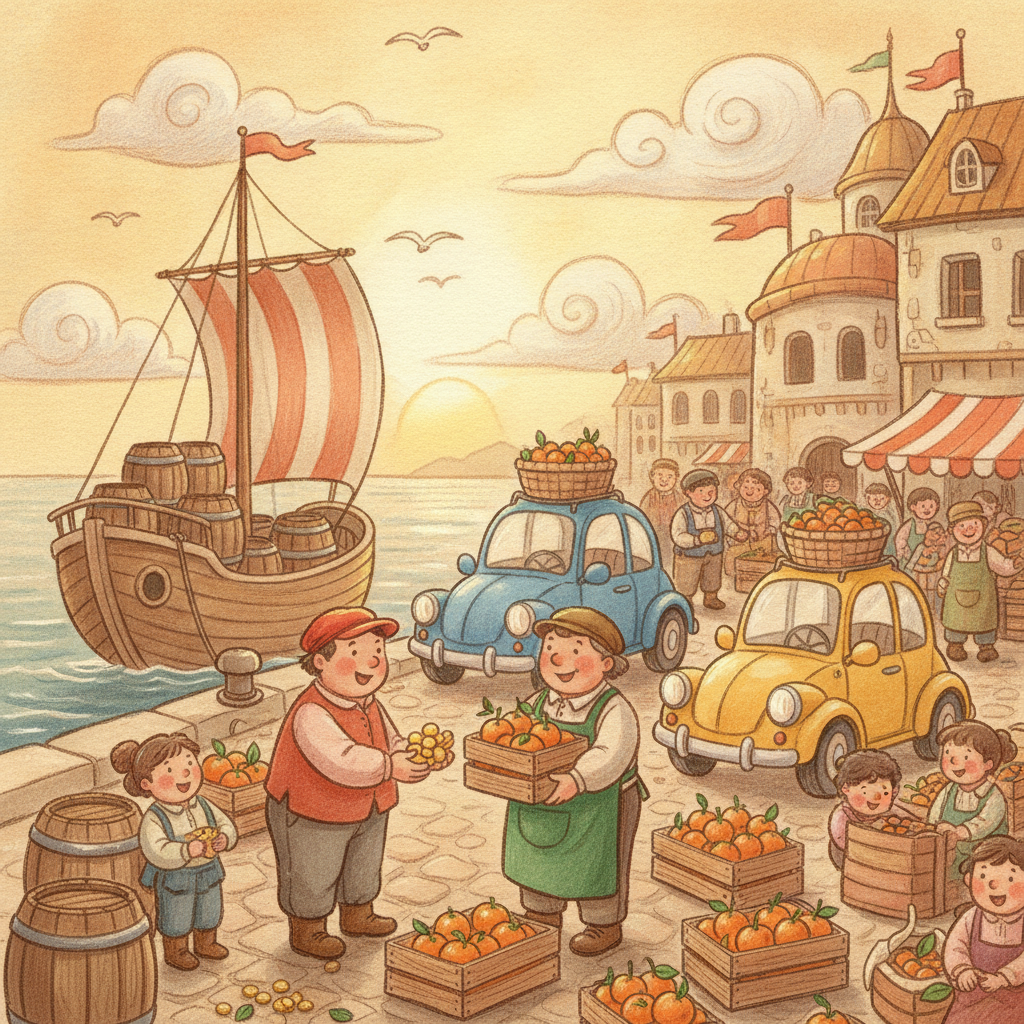
We measure every price in money, but money isn't obvious — for most of history it didn't exist. People bartered: they swapped goods directly. It worked, barely, and it was slow and clumsy. Money was invented to fix a very specific problem, and once you see that problem, you understand what money really is — and why trade, between people and between countries, leaves everyone richer.
In barter, you swap what you have for what you want — no money. The catch: it only works if the other person happens to want exactly what you're offering, at the same time. Economists call this needing a "double coincidence of wants."
Mia has extra apples and wants a haircut. But the hairdresser doesn't want apples — she wants shoes. So Mia must first find someone with shoes who wants apples, then… you can see how quickly this becomes a headache.
Money is anything everyone agrees to accept in exchange. It quietly does three jobs:
- A way to swap — everyone takes it, so no more "double coincidence" (sell apples for money, buy the haircut with money).
- A way to store value — you can save money for later; apples would rot.
- A way to measure — it puts every price in the same units, so you can compare a saddle to a bicycle.
Because money makes swapping easy, people can specialise — each do the one thing they're best at — and trade for everything else. A farmer grows food, a vet heals horses, a builder builds; each trades their work for money, then money for what others made. Countries do the same: Spain sells oranges, Germany sells cars, and both end up with more than if each tried to make everything alone.
Mia has a spare riding crop. She wants a sketchbook. The art-shop owner doesn't want a crop — he wants coffee. The café owner wants a crop! Show how Mia gets her sketchbook by barter, and count the steps.
Step 1: Mia trades her crop to the café owner (who wants it) for coffee.
Step 2: Mia trades that coffee to the art-shop owner for the sketchbook.
It took two trades and a lucky chain. With money, it's one step: sell the crop for money, buy the sketchbook. That's the whole point of money.
In one hour, Mia can groom 3 horses or paint 1 sign. Her friend Leo can groom 1 horse or paint 3 signs. A stable needs 3 horses groomed and 3 signs painted. Should they each do a bit of both, or specialise?
Specialise: Mia grooms for 1 hour → 3 horses done. Leo paints for 1 hour → 3 signs done. Total time: 1 hour each, everything finished.
If instead each did half of both, it would take longer and be done worse. By each doing what they're best at and trading, they get more done in less time. That's the power of specialisation.
-
Problem 1Explain, in your own words, what a "double coincidence of wants" means, and why it makes barter difficult.define + why it's a problem →
-
Problem 2Name the three jobs money does, and give a one-line example of each from Mia's life.swap / store / measure →
-
Problem 3Why would apples make bad money, but coins make good money? Give two reasons (think about the three jobs of money).rot? store value? →
-
Problem 4Mia has honey and wants a book. The bookseller wants candles, the candle-maker wants honey. (a) Show the barter chain that gets Mia her book. (b) How many trades did it take? (c) How many trades would it take if money existed?draw the chain → count → compare with money →
-
Problem 5A saddle costs €120 in Germany. In the UK the same saddle is £100. Using £1 = €1.15, convert the UK price to euros and say where it's cheaper. (This is money doing its "measuring" job across countries.)convert £100 to € → compare →
-
Problem 6Spain is warm and grows oranges cheaply; Germany has big factories and makes cars efficiently. Explain, using the idea of specialisation and trade, why it makes sense for Spain to sell oranges to Germany and buy cars in return — rather than each country trying to make both.who's best at what → trade → both gain →
-
Problem 7 ChallengeIn one hour, Ana can bake 4 loaves or sew 2 bags. Ben can bake 2 loaves or sew 4 bags. They need 4 loaves and 4 bags in total. (a) Who is better at baking? Who is better at sewing? (b) If they specialise, how long does it take to make everything? (c) Explain why specialising beats each doing half of both.compare skills → assign each to their best job → time it →
-
Problem 8 OpenInvent a "stable currency" for a group of kids who help at a stable — a token they earn for chores and spend on things like riding time. Describe: what the token is made of (why?), how you'd stop people from faking it, and how many tokens one hour of riding should cost. Explain how your token does all three jobs of money. There's no single right answer.your currency design →