The Water Cycle & Rivers
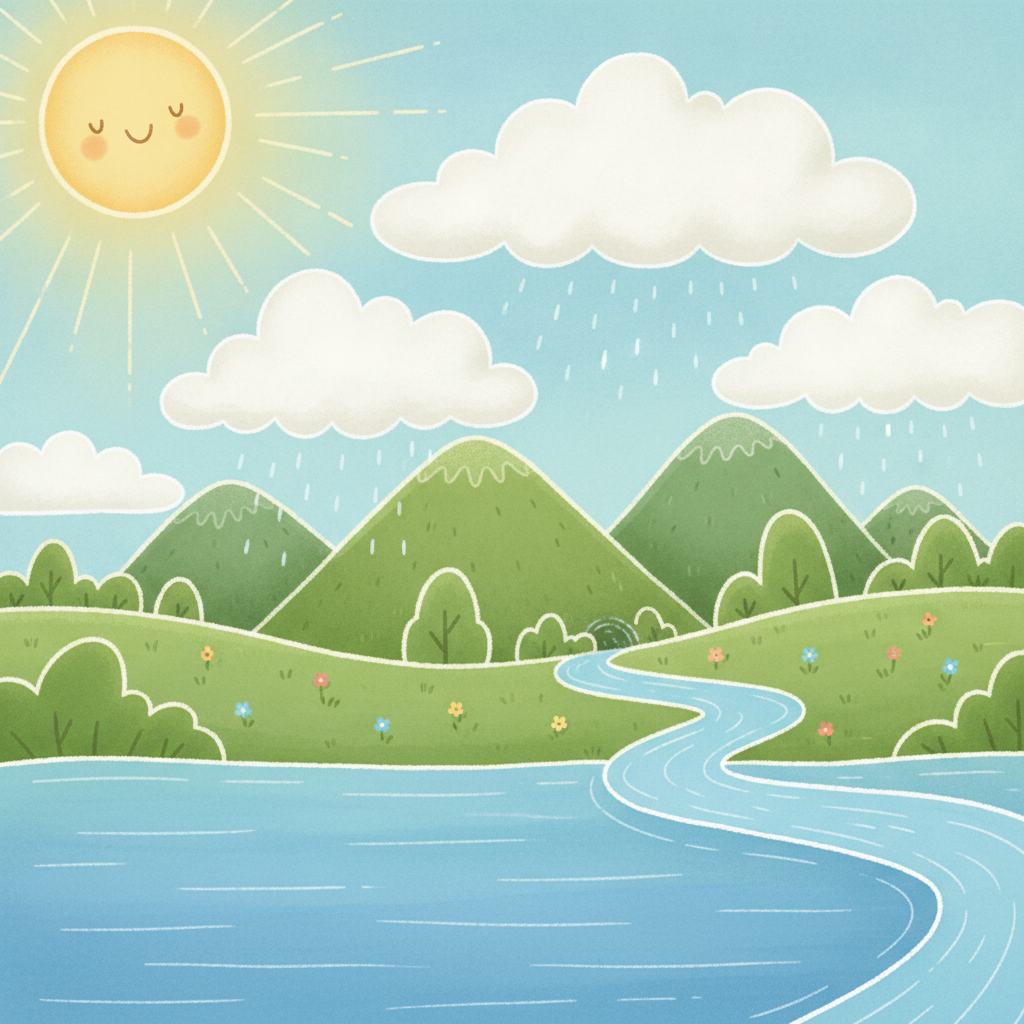
Earth has had the same water for billions of years — it just keeps going round and round. It rises invisibly into the sky, gathers into clouds, falls as rain, races down rivers to the sea, and rises again. This endless loop is the water cycle, and it explains rain, rivers, and why so many towns sit on riverbanks. Best of all, it's built from two ideas you've already met — changes of state from chemistry, and downhill slope from maths.
Water moves through four main stages, over and over:
- Evaporation — the Sun heats seas, lakes and rivers; water turns to invisible vapour and rises.
- Condensation — high up it cools, turning back into tiny droplets that form clouds.
- Precipitation — droplets join, grow heavy, and fall as rain, hail or snow.
- Collection & run-off — water gathers in rivers and lakes and flows back downhill to the sea, ready to start again.
Rain that lands on high ground flows downhill — always from high to low — gathering into a river. A river starts at its source (usually mountains), travels down, and ends at its mouth (usually the sea). Along the way the moving water erodes (wears away) rock and soil, carves valleys, and drops that material lower down — slowly reshaping the whole landscape.
This is also why so many towns sit on rivers (remember g01): fresh water, flat fertile banks, and a route to travel and trade.
Dew forms on the grass on a cold morning. Which stage of the water cycle is this, and what change of state is happening?
Air holds invisible water vapour; overnight the ground cools it until the gas turns back into liquid droplets on the grass. That's condensation — a gas → liquid change of state (the same one that fogs a cold window in your chemistry lesson).
A mountain stream falls 300 m in height over a horizontal distance of 5 km. What is its gradient (slope)?
Put both in the same units: 5 km = 5 000 m.
$$\text{gradient} = \frac{\text{fall}}{\text{distance}} = \frac{300}{5\,000} = 0.06$$A slope of 0.06 (a 6% drop). Near the sea the same river might fall only 5 m over 5 km — a gradient of $\frac{5}{5000} = 0.001$, far gentler. Rivers start steep and flatten out.
-
Problem 1Put the four water-cycle stages in the right order, starting from the sea: precipitation, evaporation, collection & run-off, condensation.order them →
-
Problem 2Name the change of state (from chemistry) happening at each stage: (a) evaporation, (b) condensation, (c) snow forming in a cloud.liquid→gas? gas→liquid? →
-
Problem 3What are the two ends of a river called — where it begins and where it finishes — and where is each usually found?source and mouth →
-
Problem 4A river falls 200 m over a horizontal distance of 4 km. Find its gradient (slope). (Remember to convert km to m first.)gradient $= \dfrac{\text{fall}}{\text{distance}}$4 km → m → divide →
-
Problem 5Explain, using the water cycle, how a puddle in a Barcelona courtyard can end up as a raincloud over the Alps. Name each stage the water passes through in order.follow the water: evaporate → … →
-
Problem 6Near its source a river's gradient is 0.08; near its mouth it is 0.002. (a) Where is the river steeper? (b) The moving water erodes (wears away) the land more where it flows faster and steeper — so where would you expect the deepest, most dramatic valleys: near the source or the mouth? Explain.compare gradients → link steepness to erosion →
-
Problem 7 ChallengeTwo rivers each drop 600 m in total. River A does it over 10 km; River B over 30 km. (a) Find each river's gradient. (b) Which is steeper, and by how many times? (c) A stable owner wants gentle, safe riverside trails for horses — which river's valley should she choose, and why?two gradients → ratio between them → choose →
-
Problem 8 OpenTrace the journey of a single raindrop from the moment it falls on a mountain to the moment it evaporates from the sea days later. Write it as a short story (5–8 steps), naming each water-cycle stage and each change of state along the way. There's no single right answer — make it vivid and correct.your raindrop's story →