Mixtures & How to Separate Them
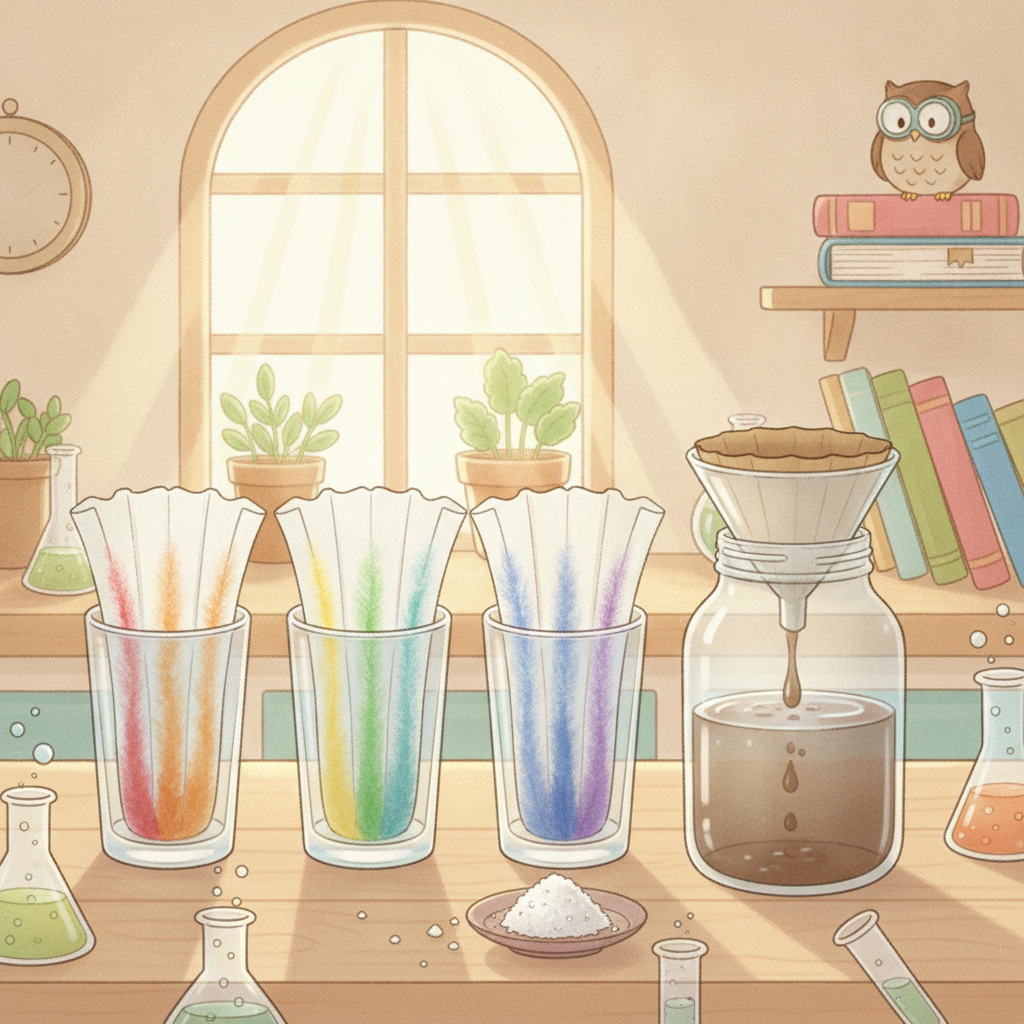
Almost nothing in the real world is pure. Seawater is water + salt + minerals. A felt-tip pen's "black" ink is usually a secret blend of blues, purples and pinks. Even the air is a mixture of gases. In this lesson you'll learn the difference between a pure substance and a mixture, meet the chemist's toolbox for un-mixing things, and use the maths you already know — ratios and percentages — to say exactly how strong a mixture is.
- A pure substance is made of only one kind of particle — nothing else mixed in (e.g. pure water, pure salt, pure gold).
- A mixture is two or more substances jumbled together but not chemically joined — so they can be separated again using physical tricks, without any reaction.
A solution is a special mixture where one thing (the solute, e.g. salt) completely dissolves and disappears into a liquid (the solvent, e.g. water). It looks clear, but the salt is still there — hiding between the water particles.
A pure substance in the particle view is all the same circles. A mixture is different circles jumbled together. Because nothing is chemically bonded in a mixture, you can always sort the circles back out — that's the whole idea behind every separation method below. Whenever a question feels tricky, draw the particles and ask: same circles, or different circles?
Every method works by finding one property where the two substances differ — size, boiling point, solubility, or how strongly they stick to paper — and exploiting it:
| Method | Splits… | Property it uses |
|---|---|---|
| Filtration | Insoluble solid from a liquid (sand from water) | Particle size — solid too big to pass the filter |
| Evaporation / Crystallisation | A dissolved solid from its solvent (salt from seawater) | Only the liquid evaporates; solid is left behind |
| Distillation | A pure liquid from a solution (fresh water from seawater) | Boiling point — the liquid boils off, then is cooled back |
| Chromatography | Different coloured dyes in an ink or dye | How strongly each colour sticks to the paper vs travels with water |
A · Secret colours (paper chromatography)
- Cut a strip from a coffee filter or kitchen paper. Draw a fat dot with a black or brown non-permanent felt-tip about 2 cm from the bottom.
- Stand the strip in a glass with just 1 cm of water — the dot must sit above the water line.
- Predict what will happen, then watch for 10 minutes. The water climbs the paper and drags the dyes with it. Colours that stick less travel further, so the "black" splits into a rainbow. Compare two different pens!
B · Grow salt crystals (evaporation)
- Stir salt into warm water until no more will dissolve (a saturated solution). Note roughly how many spoons it took.
- Pour a little into a shallow dish and leave it on a sunny windowsill for a few days.
- As the water evaporates, the salt is left behind as crystals. You separated a solution — no filter needed.
Mia's family collects water from a stream in the Bavarian hills. It has bits of grit and dead leaves floating in it, and it also tastes faintly of dissolved minerals. How would you get clean, clear, mineral-free water?
Step 1 — remove the grit and leaves: they're insoluble solids, so filter the water (property used: particle size).
Step 2 — remove the dissolved minerals: filtering won't catch dissolved particles, so distil the filtered water — boil it and re-condense the pure steam (property used: boiling point). Order matters: filter first, then distil.
A recipe for salt dough uses 50 g of salt in 200 g of water. Mia only has 150 g of water. How much salt keeps the same concentration?
$$\frac{50 \text{ g salt}}{200 \text{ g water}} = \frac{x}{150 \text{ g water}}$$ $$x = \frac{50 \times 150}{200} = 37.5 \text{ g salt}$$Same ratio, scaled down — identical to scaling a recipe. The concentration is $\frac{50}{200} = 25\%$ either way.
-
Problem 1Pure substance or mixture? (a) pure gold in a ring, (b) a smoothie, (c) tap water with fluoride and minerals, (d) a single sugar crystal, (e) sand from a beach in Mexico, (f) the air in the room.pure / mixture for each →
-
Problem 2Match the mixture to the best separation method (filtration, evaporation, distillation, chromatography): (a) sand mixed into water, (b) the colours in a green felt-tip pen, (c) getting the salt back from salty water, (d) getting drinkable water back from salty water.match each →
-
Problem 3In the words solute, solvent, solution: when Mia stirs hot chocolate powder into milk, which is the solute, which is the solvent, and what do we call the drink as a whole?label all three →
-
Problem 430 g of sugar is dissolved in 120 g of water. What is the concentration as a fraction, and as a percentage?$\dfrac{30}{120} = \; ?$simplify the fraction → × 100 →
-
Problem 5Mia does the marker chromatography experiment. On her paper strip, the black ink splits into three colours. Their distances travelled up the paper are: yellow 6 cm, red 4 cm, blue 1.5 cm.
(a) Which dye sticks most strongly to the paper (travels least)? (b) Which sticks least? (c) Explain in one sentence why the dyes end up in different places.compare distances → interpret sticking → -
Problem 6A cup holds 250 mL of seawater. When Mia evaporates all the water on a beach in Portugal, 8.75 g of salt is left. (a) What is the concentration in grams of salt per litre (g/L)? (b) The nearby Dead Sea is about 340 g/L. How many times saltier is the Dead Sea than this seawater?$250 \text{ mL} = 0.25 \text{ L}$g ÷ L → then divide the two concentrations →
-
Problem 7Mia has 300 mL of salt solution at a concentration of 40 g/L. She boils it until only 120 mL of solution is left (no salt escapes). (a) How many grams of salt were in the solution to begin with? (b) What is the new concentration in g/L? (c) Explain, using particles, why boiling makes the solution more concentrated.total salt = concentration × volume → new concentration = salt ÷ new volume →
-
Problem 8Design a step-by-step method to recover both the sand and the salt, cleanly separated, from a beaker containing sand + salt + water all mixed together. List the steps in order and name the method used at each step. (Hint: salt dissolves; sand does not.)order the steps → name each method →
-
Problem 9 ChallengeA painter mixes a custom green by combining a yellow paint and a blue paint in the ratio 3 : 2. She makes 200 mL of green in total.
(a) How many mL of yellow and how many of blue did she use? (b) Is her green paint a pure substance or a mixture — and could chromatography, in principle, "un-mix" it back into yellow and blue? Explain your reasoning. (c) She now wants 500 mL of the same green. How much of each colour?split by ratio → classify → scale up → -
Problem 10 OpenYou're given a muddy, salty puddle of water and challenged to make it as clean and drinkable as possible using only things you'd find in a kitchen (no lab equipment). Describe your plan, which properties each step exploits, and one thing you're not sure your method can remove. There's no single right answer — explain your thinking.your kitchen purification plan →