Acids, Bases & the pH Scale
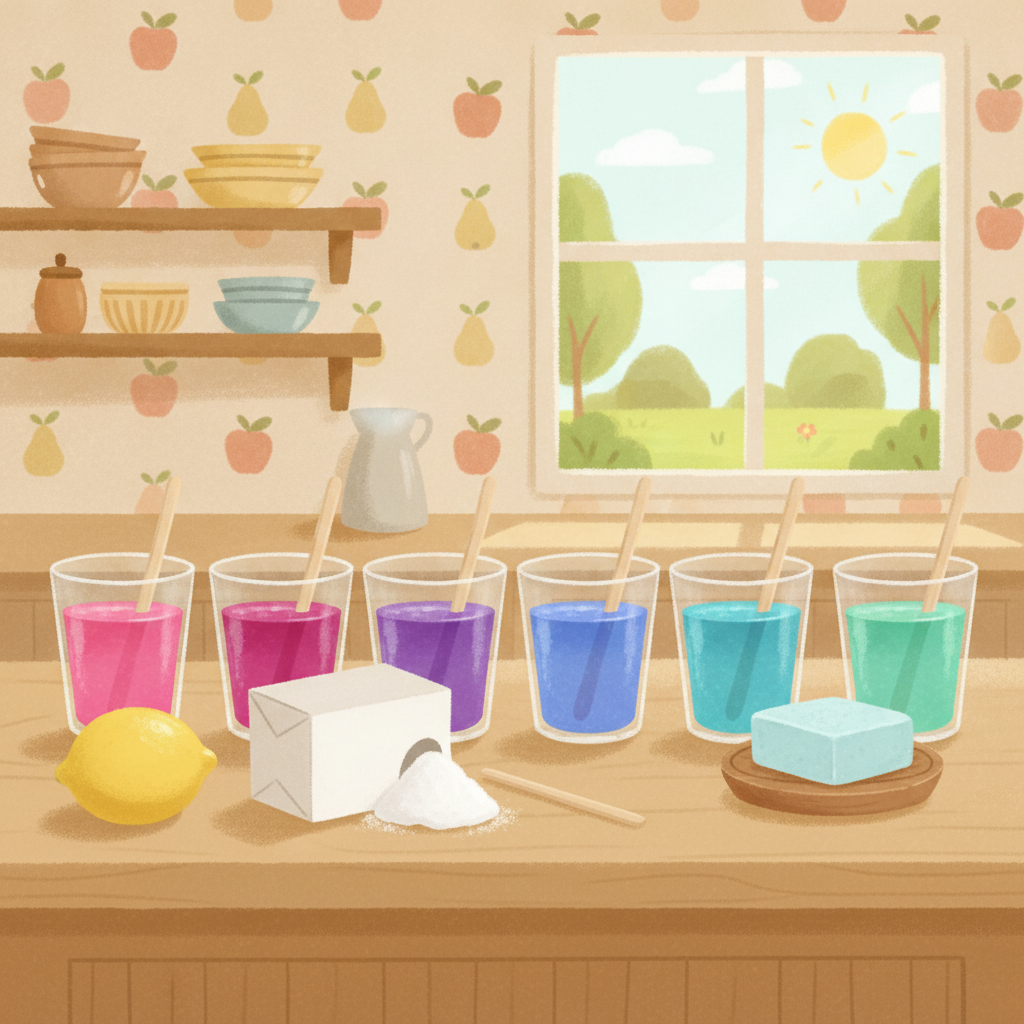
Some liquids are acids — they taste sour and can be sharp enough to dissolve metal (lemon juice, vinegar, the acid in your stomach). Others are bases (also called alkalis when they dissolve) — they feel soapy and slippery (baking soda, soap, oven cleaner). In between sit neutral substances like pure water. Chemists capture all of this in a single number from 0 to 14 called pH — and, brilliantly, its steps follow the very same "times ten" pattern as the geometric sequences you did in maths.
- Acids — pH less than 7. Sour taste, react with many metals. Examples: lemon (pH ≈ 2), vinegar (≈ 3), fizzy drinks.
- Neutral — pH exactly 7. Pure water.
- Bases / alkalis — pH more than 7. Soapy, slippery feel. Examples: baking soda (≈ 9), soap (≈ 10), oven cleaner (≈ 14).
An indicator is a substance that changes colour depending on pH — it's how you see whether something is an acid or a base.
In the particle view, an acid is a liquid crowded with special "hydrogen" particles ($\text{H}^+$); the lower the pH, the more of them there are — ten times as many for each step down. A base has almost none. When acid meets base they cancel out. Picture the particles and the number line stops being just a rule to memorise.
- Baking soda (base) soothes an acidic bee sting or acid indigestion.
- Toothpaste (mildly basic) neutralises the acids that attack your teeth.
- Farmers add lime (a base) to soil that is too acidic for crops.
- Chop a little red cabbage, cover with hot water, and leave 10 minutes. The water turns purple — that purple juice is a natural pH indicator. Strain out the cabbage.
- Pour a splash of the purple juice into several clear cups.
- Predict first, then add a different household liquid to each: lemon juice, vinegar, water, baking-soda water, soapy water.
- Watch the colours: acids turn it pink/red, neutral stays purple, bases turn it blue/green. You've built the same rainbow as the pH strip above — from a vegetable.
- Explain: the cabbage contains a dye whose shape (and colour) changes with the number of $\text{H}^+$ particles around it.
Mia tests three liquids from the kitchen. Cola reads pH 3, milk reads pH 7, and hand soap reads pH 10. Classify each, and say which is an acid, which is neutral, which is a base.
Cola pH 3 → below 7 → acid (that's the fizzy carbonic and phosphoric acid).
Milk pH 7 → exactly 7 → neutral (roughly).
Soap pH 10 → above 7 → base (that's why it feels slippery).
Lemon juice is about pH 2. Black coffee is about pH 5. How many times more acidic is the lemon juice?
$$\text{difference} = 5 - 2 = 3 \text{ steps}$$ $$\text{strength ratio} = 10^3 = 1000$$The lemon juice is 1000 times more acidic than the coffee — because each step down the scale multiplies the strength by 10 (a geometric sequence: 10, 100, 1000).
-
Problem 1Acid, base, or neutral? (a) pH 1, (b) pH 7, (c) pH 12, (d) pH 6, (e) pH 8.5.classify each →
-
Problem 2Sort these everyday liquids from most acidic to most alkaline: soap (pH 10), lemon juice (pH 2), pure water (pH 7), vinegar (pH 3), baking soda solution (pH 9).order low → high pH →
-
Problem 3Mia drops red-cabbage indicator into a mystery liquid and it turns bright pink. Is the liquid an acid or a base? What colour would she expect from soapy water?use the colour rule →
-
Problem 4Fill in the geometric pattern. Going down the pH scale, each step is ×10 stronger: pH 6 → ×1, pH 5 → ×10, pH 4 → ×____, pH 3 → ×____, pH 2 → ×____.10, 100, 1000, … →
-
Problem 5Stomach acid is about pH 1. Orange juice is about pH 4. Using $10^{(\text{difference in pH})}$: how many times more acidic is stomach acid than orange juice?difference $= 4 - 1 = ?$count steps → 10 to that power →
-
Problem 6A stable's soil is measured at pH 5 (too acidic for good grazing grass). Grass grows best around pH 7. (a) How many pH steps must the soil rise? (b) Each step means the acidity is divided by 10 — by what total factor must the acidity drop to reach pH 7? (c) The farmer adds lime, a base. Explain in one sentence why adding a base raises the pH.steps → 10^steps → why base raises pH →
-
Problem 7Mia tests rainwater at three cities on her travels and records the pH:
City Rain pH Clean mountain air (Alps) 6 City with some pollution 5 Heavily polluted valley 4 (a) Which rain is the most acidic? (b) How many times more acidic is the polluted-valley rain than the Alps rain? (c) "Acid rain" damages stone statues and leaves. Which reading should worry a city most?compare → 10^(difference) → interpret → -
Problem 8Mia is stung by a wasp (wasp stings are alkaline, around pH 9). She has two things nearby: vinegar (pH 3, acidic) and baking-soda paste (pH 9, alkaline). (a) Which should she dab on the sting to neutralise it, and why? (b) What does "neutralise" mean in terms of the pH number? (c) In the particle view, what happens to the extra particles when acid meets base?choose the opposite → define neutralise → particles cancel →
-
Problem 9 ChallengeAn acid at pH 2 is 100,000 times more acidic than a certain base. (a) Using $10^{(\text{difference})} = 100{,}000$, how many pH steps apart are they? (b) What is the pH of the base? (c) Is your answer an acid, neutral, or a base — does that make sense with the word "base" in the question?100000 = 10^? → add steps to pH 2 → classify →
-
Problem 10 OpenUsing only red-cabbage indicator and things in a kitchen, design an experiment to rank five household liquids from most acidic to most alkaline without ever tasting or touching them. Describe how you'd build a colour "key" to read off an approximate pH, what you'd keep the same for a fair test, and one liquid whose result you genuinely can't predict. There's no single right answer — explain your reasoning.your indicator experiment + colour key →